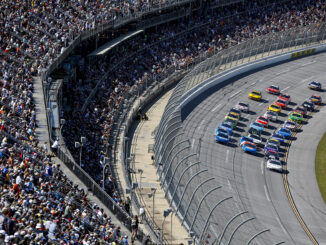

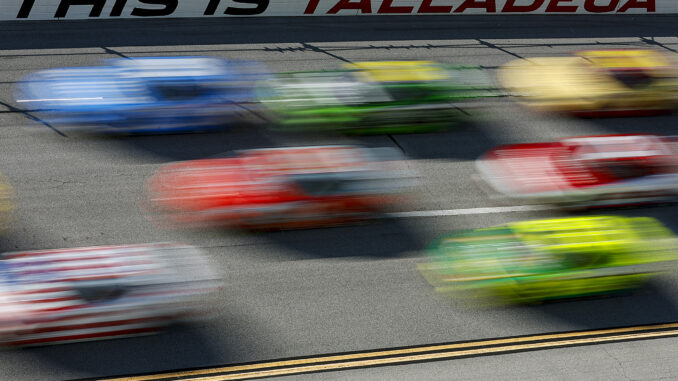

Superspeedway racing on the NASCAR Cup Series schedule has drawn huge complaints from fans of the sport in recent years due to the fuel saving that goes on due to the stages causing scheduled pit stops to create the optimal shortest stops and lower the amount of required stops.
In a shift from recent years, NASCAR is looking to make adjustments and beginning to once again value fan, team, and media input in major decision making. A solid example of this was shown this week when NASCAR decided to alter the stage lengths of Talladega’s Jack Link’s 500 which is set for April 26th.
A major complaint during the Daytona 500 back in February was the fuel saving concerns. A large chunk of the race was the pack sitting 3-wide, turning less than stellar lap times at 80 percent throttle. That isn’t conducive to exciting racing. In the final laps when “the race was on” it was action packed and there were numerous passes and accidents. NASCAR is hoping flipping the stage splits of Superspeedway racing to the first stage being the longest and the latter stages being short runs that match the length of a fuel window they can manufacture more exciting racing.
The new split for Talladega will be: Stage 1: 98 Laps, Stage 2: 45 Laps, Stage 3: 45 Laps. This is a drastic change from the 60/60/68 split that had been in place at Talladega Superspeedway for the NASCAR Cup Series.
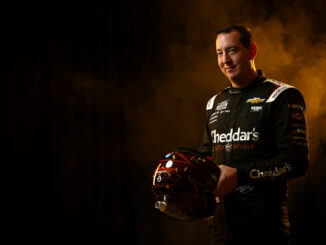
NASCAR Executive Vice President and Chief Racing Development Officer John Probst gave a statement in a press release on April 13th regarding the change:
“Coming out of Daytona we have been working hand-in-hand with a lot of our race teams trying to largely break into two categories things we could do. One are sporting related things, things like rules around pit stops or stage lengths or things of that nature. The other being in a technical bucket, which would mean car changes: spoiler, power level, things of that nature….
“As we went through all of our options, not just with NASCAR but even with the teams, there’s a little bit of reluctance to just make wholesale changes to any of the technical stuff in the middle of the season for fear of the unintended consequences.
“If you look at generally how a lot of our speedways were laid out it was a short stage, a short stage and then a long stage to the end. Going into Talladega, we’re going to flip that and adjust the lengths of the final two stages such that we’re confident that the last two stages are short enough to be made without a fuel stop.
“It could be interesting, as well, in that first stage, the length of it, if there’s some that try to do it on one stop versus some that try to do it on two. We think that if there are some that try to do it on two, they may drag the group that tried to do it on one along with them to where they won’t be able to do it in one, so it’s got the potential there for some pretty interesting strategies.”
It will certainly change the racing at Talladega and likely reward better driving ability and car set up as opposed to the best strategic setup.
The past 3 winners of Cup races at Talladega are Chase Briscoe (Oct. ’25), Austin Cindric (Apr. ’25), and Ricky Stenhouse Jr. (Oct. ’24).